Stone Devlog: Hertz So Good
To kick off the refinement of the knapping system, I decided to hit the books again. Watching videos on flint knapping had become a bit of a pastime for me and I thought I had a handle on how the process went. However, it wasn't until recently that I dug into some more academic resources and really wrapped my head around it.
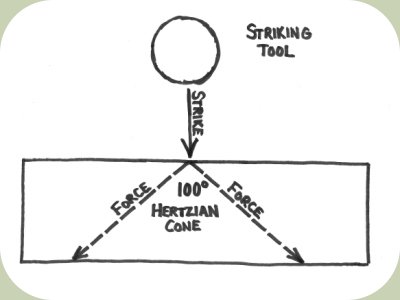
Not long after lamenting that simple geometric primitives were not going to be sufficient to create a convincing knapping system, I learned that real-life knapping does (somewhat) boil down to subtracting a geometric primitive. Introducing the Hertzian Cone:

The short of it is, when you strike certain brittle materials (like flint), the force propagates from the point of impact through the material in a distinctive cone. The portion within the cone is essentially blown out of the object when it is struck. Sources have been a little light on specifics, but apparently the angle of the cone is typically about 100 degrees, though it can vary and evidently can be controlled to an extent.
 |
| From wildernesscollege.com |
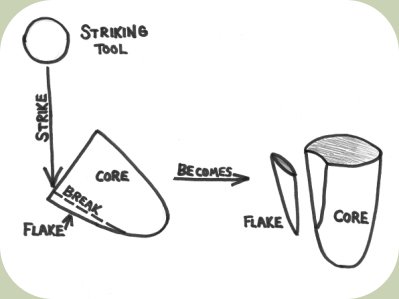
This almost seems too good to be true. You can't just tap a big rock right in the middle and extract a perfect cone from it, so there is certainly a bit more to the physics of it. However, the basic principle of real-life knapping is striking along an edge at an angle such that the cone catches a small sliver of the object.
 |
| Also from wildernesscollege.com |
It was fortunate that the cone was one of the SDFs I implemented in my bid to stall for time a few months back. It took some doing to properly transform the cone to the rotation of the "stone", but once I did, it started coming together. At first, I wasn't entirely convinced, but it quickly grew on me as I continued to learn about real flint knapping and applied the principles while using my system. Next time we will take a look at the current state of cone-y knapping. Stay tuned.